
The document just learned to think for itself. It didn’t need permission from the network to do it.
A nurse pulls up a full patient history in a basement radiology suite with zero bars. A wealth advisor reviews a client’s complete portfolio thirty thousand feet over the Atlantic. A rural health worker in a clinic that loses power twice a week still has last month’s numbers, this month’s numbers, and the ability to compare them, without asking a server for permission.
None of that should be remarkable. In 2026, it still is. That’s not a hardware problem. It’s a format problem. The PDF and the dashboard, the two formats nearly every business report is trapped inside, were both built for a world where a connection was assumed, a screen was assumed, and a desk was assumed. Most of the working world doesn’t reliably have any of the three.
About 80 percent of the global workforce, roughly 2.7 billion people, does not do its job from behind a desk.1 Add the nearly one in three people worldwide who still lack reliable internet access,2 and you get an uncomfortable fact: the documents businesses spend the most money producing are formatted for the minority of people who happen to be sitting down, online, when they open them.
A new architecture changes that math entirely, and in the process, it quietly retires the two formats that have run the document world for thirty years.
1. Born Frozen
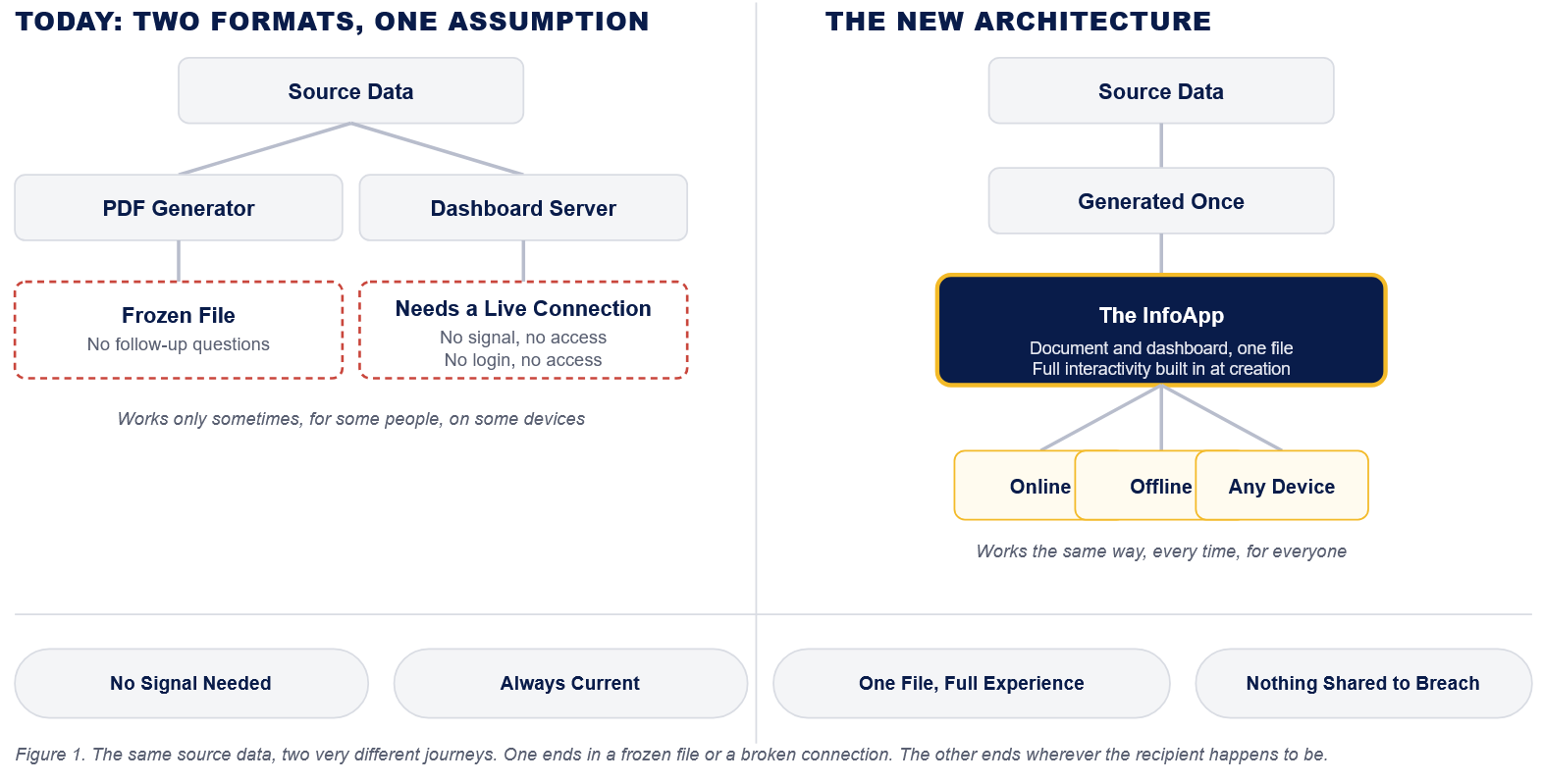
The PDF was a genuine breakthrough. It let a document look exactly the same on any printer, any screen, anywhere in the world, at a time when that was nearly impossible. That single guarantee, perfect reproduction, made it the default container for every statement, report, and disclosure that followed.
The tradeoff has aged badly. A PDF is a photograph of data, not a relationship with it. The moment it renders, the clock starts on its own obsolescence. It cannot be asked a follow-up question. It cannot be recalculated, resorted, or compared against last quarter without a second file. Every question the document didn’t anticipate becomes someone else’s problem, usually a phone call, an email, or a support ticket.
2. Born on a Leash
Dashboards were the industry’s answer to that exact limitation, and for years they delivered on it. A dashboard lets someone filter, drill down, and explore, instead of just reading. But a dashboard never actually leaves home. It lives on a server, behind a login, and the moment the connection drops, so does the experience.
The analytics industry has quietly started admitting this itself. More than 60 percent of organizations now embed analytics directly inside the applications people already use, rather than sending them to a standalone dashboard, according to Gartner’s 2025 BI and Analytics Platforms research.3 Nearly half of BI users try to reach their dashboards from a mobile device, and most run into the same wall: the dashboard was built for a desk, not a device.4 Meanwhile, more than half of end users still say they lack confidence using the BI tools they’ve been given, despite the vast majority of leadership calling data literacy essential.5 That’s not a training problem. That’s a sign the format itself is fighting the people it was built for.
3. The Architecture That Ends the Argument
The fix isn’t a faster PDF or a lighter dashboard. It’s a different kind of document altogether, one generated once, carrying its complete interactive experience with it, the same way a good field manual carries everything a technician needs without needing a cell signal to check.
Call it what it is: a document that behaves like a dashboard and travels like a file. It opens on a laptop, a tablet, or a phone. It filters, sorts, and recalculates the same way a live dashboard would, because the interactivity was built in at the moment of creation, not bolted on afterward through a server call. And because everything it needs is already inside it, it works exactly the same whether the recipient is on fiber, on one bar, or on nothing at all.
4. What Changes When the Document Doesn’t Need Permission
- It works. Anywhere. Full stop. On a plane, in a basement, at a remote job site, in a village without a tower. No spinner. No “check your connection.” The experience people get on a fast office network is the same one they get with zero bars.
- It stays current without a rebuild request. Every generation cycle produces a fresh one. Nobody has to file a ticket asking IT to add a filter to a dashboard, because the whole interactive experience already travels inside the file itself.
- It ends the PDF-or-portal decision. Nobody has to choose between “email them the PDF” and “give them portal access.” One object does both jobs at once, completely.
- It’s private by nature, not by policy. Each one only ever carries what its one recipient is allowed to see. There’s no shared system sitting in the middle for anyone to break into.
- It goes where the people already are. To the 2.7 billion people who don’t work at a desk. To the third of the planet that isn’t reliably online. To the hospital basement, the disaster zone, the offshore rig, the rural clinic, the airplane seat.
Reports
Dashboards
Field Data
Clinical Records
Regulatory Filings
5. The End of Two Categories
The PDF had one job, look exactly the same everywhere, and it did that job for thirty years. The dashboard had one job, let people ask questions of live data, and it did that job for about fifteen. Neither was ever built to do both. Neither was built to work without the network’s blessing. And as more of the world’s data creation moves to the edge, closer to where people actually are instead of a distant data center, that gap only gets more obvious.6
The document that does both jobs, and asks nobody’s permission to do either, isn’t a better PDF or a smarter dashboard. It’s the thing that makes the question “should this be a PDF or a dashboard” stop making sense. That question only existed because no format could do both. Now one does.